An Enduring Masterpiece of Love and Marble
Imagine a monument so exquisite it has inspired poets, artists, and dreamers for centuries. A place where love and beauty are forever enshrined in ivory-white marble, standing as a testament to the heights of human creativity and devotion. Welcome to the Taj Mahal in Agra, India — an architectural marvel that transcends time and is universally celebrated as the ultimate symbol of love.
The Love Story Behind the Marble
To truly appreciate the Taj Mahal, one must understand the profound love story that brought it into existence. In 1612, the Mughal Emperor Shah Jahan married Arjumand Banu Begum, who he later crowned Mumtaz Mahal (“Jewel of the Palace”). She was not just his wife; she was his closest confidante, his political advisor, and his inseparable companion, accompanying him even on grueling military campaigns.
Tragedy struck in 1631 in Burhanpur. While accompanying Shah Jahan on a campaign to crush a rebellion, Mumtaz Mahal died giving birth to their 14th child. The emperor was shattered. Legend says his hair turned white overnight from grief. Consumed by sorrow, Shah Jahan vowed to build a monument that would be unrivaled in beauty for all generations — a physical manifestation of his immense love.
An Architectural Symphony
Construction began in 1632 and took nearly two decades to complete. Shah Jahan envisioned an earthly replica of Mumtaz Mahal’s celestial abode in paradise. The scale of the project was staggering:
- The Workforce: A massive labor force of 20,000 artisans, craftsmen, stone-carvers, and calligraphers from across India, Persia, the Ottoman Empire, and Europe were brought in.
- The Logistics: Over 1,000 elephants were deployed to transport materials.
- The Materials: Translucent white marble was brought from Makrana (Rajasthan), jasper from Punjab, jade and crystal from China, turquoise from Tibet, lapis lazuli from Afghanistan, sapphire from Sri Lanka, and carnelian from Arabia.
The chief architect, Ustad Ahmad Lahori, masterminded the profound fusion of Persian, Islamic, and Indian architectural styles. The result is a structure of perfect, flawless symmetry. The mausoleum, the main gateway, the mosque, and the jawab (guest house) are completely symmetrical. The only asymmetrical object in the entire complex is Shah Jahan’s own casket, placed next to his queen’s as an afterthought upon his death.
The Magic of Changing Colors
The Taj Mahal is dynamic; it responds to the light of the day. The English poet Sir Edwin Arnold famously described it as “Not a piece of architecture, as other buildings are, but the proud passions of an emperor’s love wrought in living stones”.
- Morning: In the early hours, it appears soft and pinkish, floating gently in the morning mist.
- Midday: Under the bright sun, the marble turns a brilliant, searing white.
- Evening: As the sun sets, it glows with a warm, milky golden hue.
- Night: During a full moon, the semi-precious stones inlaid in the marble catch the moonlight, making the entire monument sparkle like a jewel.
Planning Your Journey
Designated a UNESCO World Heritage Site in 1983 and voted one of the New Seven Wonders of the World, the Taj Mahal attracts approximately 8 million visitors annually.
| Detail | Information |
| Location | Agra, Uttar Pradesh (Approx. 2.5 hours from Delhi via the Yamuna Expressway) |
| Best Time to Visit | October to March (cooler weather). Arrive at sunrise to beat the massive crowds and see the softest light. |
| Tickets | ₹50 for Indians, ₹1100 for foreigners (an additional ₹200 is required to enter the main mausoleum). |
| What to Bring | Only essentials (wallet, camera, phone). Security is strict; large bags and tripods are not allowed. |
Beyond the Taj: Completing the Experience
While the Taj Mahal is the crown jewel, Agra has other remarkable monuments that tell the story of the Mughal era:
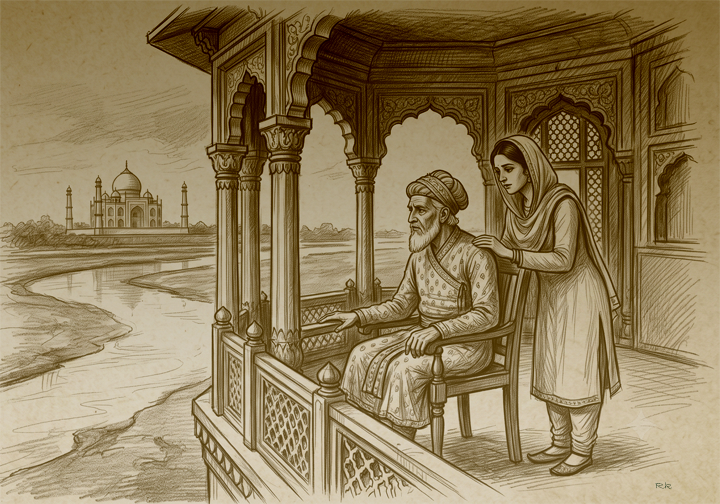
- Agra Fort: The formidable red sandstone fortress where Shah Jahan was eventually imprisoned by his own son, Aurangzeb. From his balcony here, the deposed emperor spent his final years gazing across the Yamuna River at the Taj Mahal.
- Itmad-ud-Daulah (Baby Taj): Built before the Taj Mahal, this beautiful tomb was the first Mughal structure made entirely of marble and is believed to be the design draft for the Taj.
- Mehtab Bagh: Located directly across the Yamuna River, these gardens offer a stunning, peaceful view of the Taj Mahal away from the main crowds, especially spectacular at sunset.
The Taj Mahal is not merely a monument; it is an emotion. As you walk through its magnificent archways and witness the sheer dedication carved into every inch of its surface, you aren’t just seeing history — you are feeling it.
The history of Agra Fort Click to open side panel for more information is a sweeping tale of empire, architectural brilliance, and ultimately, a tragic familial betrayal that profoundly defined the final days of Shah Jahan.
From Military Fortress to Palatial Marvel The foundation of the massive red sandstone fort we see today was laid by Shah Jahan’s grandfather, Emperor Akbar, in 1565. For generations, it served primarily as a formidable military garrison and the seat of government for the Mughal Empire in Agra. However, when Shah Jahan took the throne, he began transforming the fort into a lavish palace. Known for his intense love of exquisite white marble, Shah Jahan demolished some of the earlier sandstone structures within the fort’s imposing walls to build elegant courtyards, audience halls, and private quarters.
The War of Succession and Betrayal The tragic turning point in Shah Jahan’s life occurred in 1658 when he fell gravely ill. Believing his death was imminent, his four sons immediately plunged into a brutal, bloody war of succession. His third son, Aurangzeb, emerged as the most ruthless and militarily capable. Aurangzeb defeated his brothers, declared himself the new Mughal Emperor, and seized control.
Even though Shah Jahan eventually recovered from his illness, Aurangzeb refused to relinquish power. Instead, he staged a coup and placed his own father under strict house arrest within the very fort Shah Jahan had spent so much time beautifying.

Musamman Burj
📍 Building
A Prisoner in the Musamman Burj Click to open side panel for more information For the final eight years of his life, the once-mighty emperor who had commanded vast armies and immense wealth was confined to a specific section of the fort called the Musamman Burj. This exquisitely carved, octagonal white marble tower features a beautifully intricate balcony. Ironically, Shah Jahan had originally built this luxurious pavilion for his beloved wife, Mumtaz Mahal.
The View of the Taj Mahal
The location of his imprisonment is one of history’s most poetic and heartbreaking details. The Musamman Burj was strategically designed to offer a direct, unobstructed view across the meandering Yamuna River straight to the Taj Mahal. Stripped of his power, his freedom, and his empire, Shah Jahan spent his final years as a prisoner gazing out from this balcony at the magnificent mausoleum he had built for his soulmate. He was cared for during this time by his devoted eldest daughter, Jahanara Begum, who voluntarily shared his confinement.
In January 1666, at the age of 74, Shah Jahan passed away. According to historical accounts and enduring legends, his dying eyes were fixed upon the shimmering white dome of the Taj Mahal. Following his death, his body was quietly ferried across the river without state honors and laid to rest inside the mausoleum, directly beside Mumtaz Mahal, finally reuniting them in eternity.

Taj Mahal
4.6
📍 Monument
The architecture of the Taj Mahal Click to open side panel for more information is a breathtaking masterclass in Mughal design, perfectly blending Islamic, Persian, and Indian architectural styles. Beyond its visual beauty, every stone, angle, and pattern was deliberately chosen to convey a profound spiritual and symbolic message: the recreation of Paradise on Earth.
Here is a breakdown of its key architectural elements and their hidden meanings:
1. Absolute Symmetry and the Divine Order
The defining characteristic of the entire complex is its flawless bilateral symmetry. From the gardens to the flanking buildings, everything is a mirror image of the other side.
- Symbolism:
- In Islamic architecture, perfect symmetry represents the divine order and balance of the universe. The only asymmetrical feature in the entire complex is the placement of Shah Jahan’s cenotaph, which was added beside Mumtaz Mahal’s perfectly centered tomb after his death.
2. The Charbagh (Four-Part Garden)
The monument is set at the end of a vast, meticulously planned geometric garden divided into four main quadrants by water channels.
- Symbolism: This layout represents the Islamic concept of Jannah (Paradise). According to the Quran, Paradise is a lush garden intersected by four flowing rivers of water, milk, wine, and honey. The central water basin, the al-Hawd al-Kawthar, represents the celestial pool of abundance where the faithful quench their thirst upon arriving in Paradise.
3. The Main Dome and the Lotus Motif
The massive, onion-shaped central dome (often called an amrud or guava dome) reaches a height of roughly 73 meters (240 feet) and rests on a cylindrical drum.
- Symbolism:
- The dome represents the vault of heaven. It is crowned by an inverted lotus motif, a classic Hindu and Indian architectural element signifying purity, rebirth, and spiritual awakening. This beautifully demonstrates the synthesis of Islamic and Indian styles.
4. The Four Minarets
Four towering minarets frame the main mausoleum. Unlike traditional working minarets used to call the faithful to prayer, these were largely decorative.
- Architectural Brilliance:
- If you look closely, the minarets are not perfectly straight; they tilt slightly outward. This was a genius engineering choice by Ustad Ahmad Lahori. If a massive earthquake were to occur, the minarets would fall outward away from the main tomb, protecting the precious dome from destruction.
5. Parchin Kari (Pietra Dura) Inlay Work The pristine white Makrana marble is adorned with mesmerizingly intricate inlay work. Artisans carved exact depressions into the marble and fitted them with highly polished semi-precious stones (like lapis lazuli, jade, and carnelian) to create blooming vines and flowers.
- Symbolism:
- Because Islamic art strictly forbids the depiction of human or animal forms, the artisans used botanical motifs to decorate the tomb. These perpetual, unfading flowers symbolize the eternal, blooming gardens of Paradise waiting for the departed soul.
6. The Calligraphy The grand arches and entryways are bordered by stunning calligraphy of verses from the Quran, inlaid with black marble.
- Architectural Illusion: The calligrapher, Amanat Khan, used an incredible optical trick. The lettering gradually increases in size as it goes higher up the archway. To someone standing on the ground looking up, the text appears perfectly uniform in size.
- Symbolism: The verses chosen deal primarily with themes of divine mercy, the Day of Judgment, and the rewards of Paradise. The calligraphy around the great gate famously invites the reader: “O Soul, thou art at rest. Return to the Lord at peace with Him, and He at peace with you.”
7. Color Contrast: Marble and Sandstone The radiant white marble mausoleum is flanked on either side by two identical red sandstone buildings: a working mosque on the west, and a jawab (guest house) on the east to maintain symmetry.
- Symbolism: In ancient Indian traditions, white stones were often reserved for the priestly class (Brahmins) and temples, while red stone was associated with the warrior class (Kshatriyas) and imperial power. The Mughals adopted this, using red sandstone for their forts and palaces, but reserving the purest white marble for the most sacred and divine spaces, effectively elevating the Taj Mahal to the status of a holy sanctuary.